

Coming down the Cordova hill
Originally uploaded by t-dawg.
In keeping with the significance of this event, I am going to write an epic-length post providing some history of the event and an account of our witnessing the ceremonial start in Anchorage. In a later post (perhaps more than one) I will provide an update on the current race status. And at the end of next week, I am traveling to Nome to watch the finish of the race!!
History of the Iditarod
The Iditarod Trail was, at one time, a major thoroughfare across Alaska. Heavy use of the trail began during the many gold rushes between 1880 and 1914, and the trail was used to deliver mail, supplies, and people to the many settlements in the harsh interior of Alaska.
 In the winter, the only way to travel long distances on the trail was by dog team. But as the advent of airplanes allowed supplies and people to be transported over long distances, the Iditarod trail fell out of use. Dog teams continued to be used for local work and transportation, but eventually, the now-ubiquitous snowmachine took over in even these uses, and the use of dog teams declined dramatically.
The Iditarod Trail Sled Dog Race was conceived in the late 60s by Dorothy Page as something of a return to tradition and a savior of mushing lore and heritage in danger of being lost in the modern age. The first Iditarod race, in the form it is known today, took place in 1973 (there were a couple of shorter races in the late 60s). The U.S. Army helped clear the parts of the trail that were not already being used as winter snowmachine trails. The 1973 race had 34 entrants, 22 of whom finished the race, and the winner crossed the finish line after just over 20 days.
For more history, see the official Iditarod history page or the Iditarod’s Wikipedia article.
Today’s Iditarod
Today, mushers race over 1150 miles through some of the most extreme weather and terrain in the world, beginning (technically) in Anchorage, and ending in Nome. (My favorite fact: although the actual length of the race is over 1150 miles, the official distance is set at 1049 miles, to commemorate Alaska’s status as the 49th state to join the union.) The record finish was in 2002--Martin Buser (running the race again this year) finished in just 8 days and 22 hours. Average winning times for the past 10 years are between 9 and 11 days. Alaskan Jeff King won in 9 days 11 hours last year.
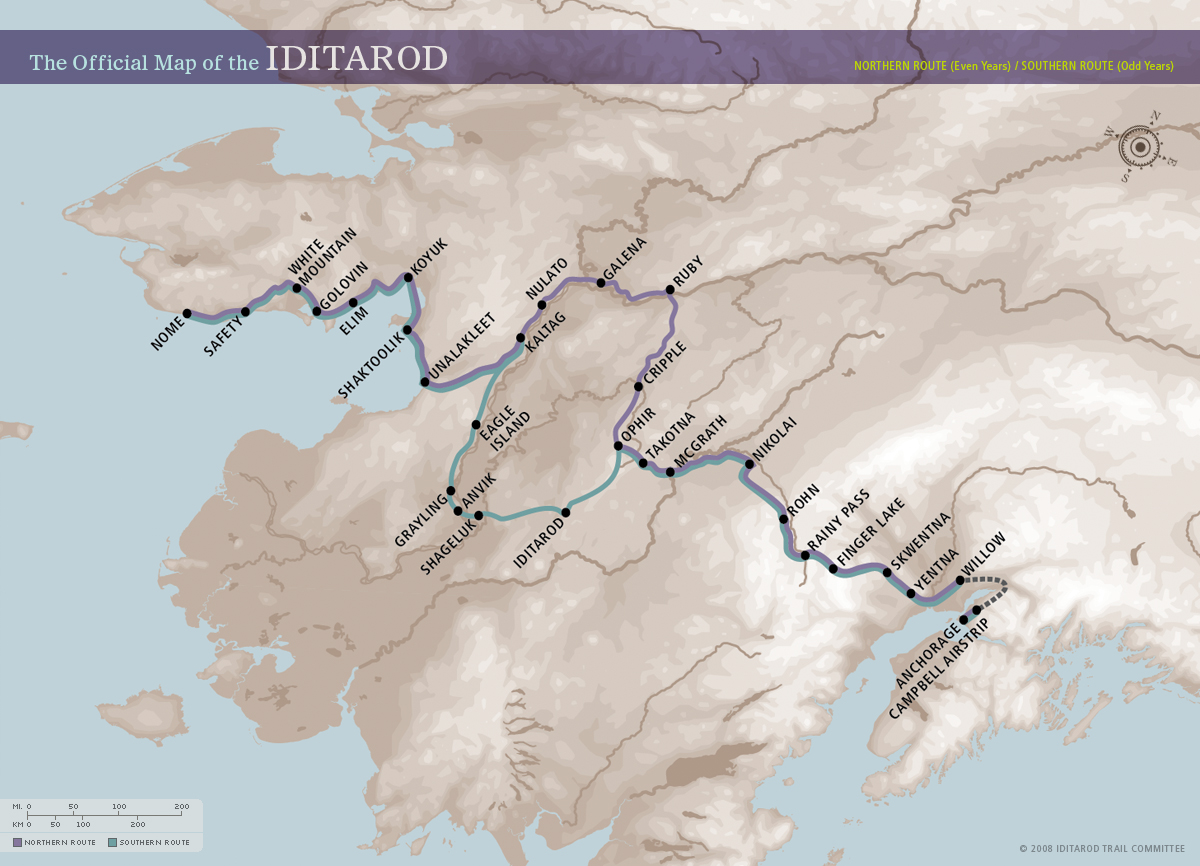
Above is a map of the Iditarod Trail. The route is almost the same every year, with the exception of one stretch in the middle--after the checkpoint Ophir, the trail bends north in even-numbered years, and south in odd-numbered years. This year, mushers are running the southerly route. Before the race, a volunteer air force delivers dog food and other supplies to each of the checkpoints for the mushers to refuel.
There are many complicated and fascinating rules governing the race--14 pages worth. Mushers must start with between 12 and 16 dogs, and must have at least 5 dogs when crossing the finish line. Mushers must check in at all 26 checkpoints along the trail, and there are three mandatory resting periods--two 8-hour and one 24-hour--that each musher and team must take during the course of the race. The dogs are checked by a vet before the race and at every checkpoint to make sure each one is fit to continue. Mushers are not allowed to tie one team to another, except in an emergency. No outside assistance is allowed, nor are mushers allowed to use night vision goggles or GPS devices. But my favorite rule is:
Rule 33 -- Killing of Game Animals: In the event that an edible big game animal, i.e., moose, caribou, buffalo, is killed in defense of life or property, the musher must gut the animal and report the incident to a race official at the next checkpoint. Following teams must help gut the animal when possible. No teams may pass until the animal has been gutted and the musher killing the animal has proceeded.Each musher who finishes gets at least $1,049 in winnings, but the bulk of the purse--almost $800K this year--is distributed to the top 30 finishers.
Anchorage ceremonial start
Since 1983, the Iditarod has started in downtown Anchorage. But this start is merely “ceremonial”--the course through Anchorage, ending this year at the Campbell air strip, is not timed, and the race officially re-starts in Wasilla, about 40 miles from Anchorage. The reason for this jump is apparently that to run a dogsled from downtown Anchorage, where it is easy for spectators, tourists, and the media to watch the event, to the Iditarod Trail itself would require crossing freeways.
Starting early Saturday morning, 83 mushers and over 1000 beautiful sled dogs packed into the downtown blocks preparing for the ceremonial start. It was glorious mayhem! I haven’t seen that many people in one place in Alaska--maybe ever. There were some fascinating characters in full fur getups--some with entire wolf or fox bodies draped over themselves.

Fox!!!!!
Originally uploaded by t-dawg.
Dogs are transported to the area in trucks with tiny slots for each dog. Just like with the race a couple weeks ago, the streets, now bare since we haven’t had new snow in a while, were covered with trucked-in snow. One team started every two minutes until all 83 teams were on their way. It was super-crowded downtown, but as we walked along the trail, with teams passing us every two minutes, crowds thinned out and we were able to stand right alongside the running teams--we could have reached out and touched them! The first treacherous bit of trail is the turn at 4th and Cordova--teams come whipping around the corner, very exciting. But the best place to watch was on the Cordova hill. Teams come flying down the hill--apparently their brakes don’t work that well on the few inches of snow tossed on top of the street. This dog tried to reach out and lick (bite?) me:

Coming over the Cordova hill
Originally uploaded by t-dawg.
It’s so exciting to have witnessed such a historic event. Since the start, I’ve been obsessed with following the progress of the mushers. A successive post will provide updates on race progress. And tonight, we will have a screening of the fantastic Iditarod movie (tragically not filmed in Alaska) Iron Will.
Stay tuned.

No comments:
Post a Comment